

Genetic Screening
Before Your First Appointment:
Learn About Genetic Screening
Before your first appointment, we encourage you to spend some time learning about prenatal genetic screening options so you can come prepared with questions or an idea of what feels right for you.
These screening tests are optional and are designed to estimate the likelihood (not a diagnosis) of certain genetic conditions in your baby. Most screening tests are done early in pregnancy and do not pose a risk to your baby. The screening options offered to you may vary depending on factors such as your age and medical history. It’s important to understand that these tests provide probabilities only — they cannot tell us with certainty whether your baby has a genetic condition. Your care provider will review these options with you during your first prenatal visit and help you decide what aligns best with your values and preferences.
Some screening tests are covered by MSP, while others are available through private pay. Certain tests may also include the option to learn your baby’s sex, if desired. If you are requesting sex results, please note that results are typically available a minimum of four business days after your ultrasound and 10 business days after private blood (NIPT/Harmony) testing.
For more detailed, up-to-date information, we recommend reviewing the resources from BC Prenatal Screening, linked below.
Learn About Your Genetic Screening Options
It's your choice whether or not to have prenatal genetic screening during your pregnancy. Learn more about the BC Prenatal Genetic Screening Program and what your options are.
Funded Prenatal Genetic Screening: How the Process Works
In British Columbia, prenatal genetic screening is publicly funded through MSP and available to all eligible pregnant people. These optional tests are designed to estimate the chance of certain genetic conditions and are a safe, non-invasive first step for many families.
-
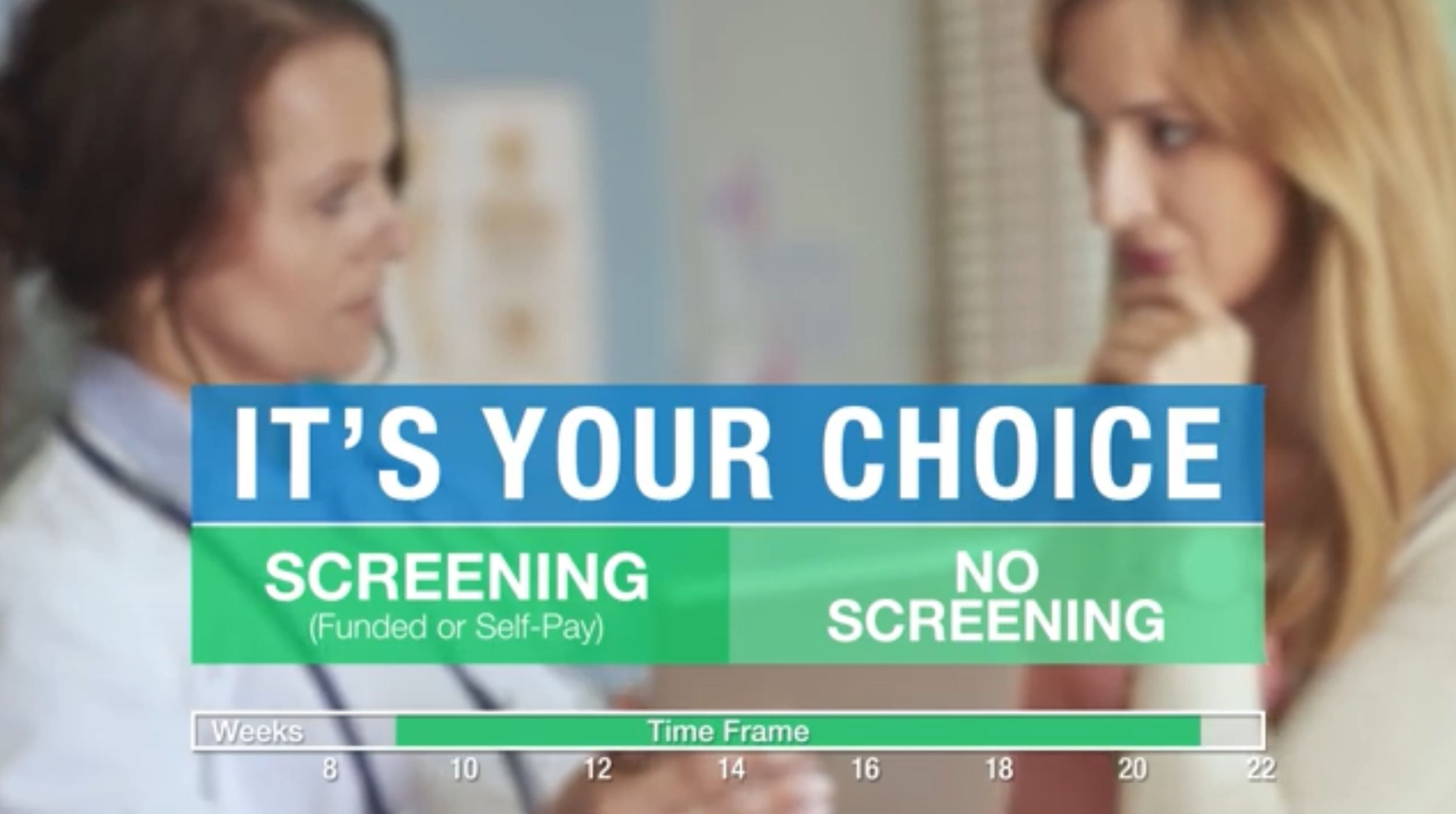
Prenatal genetic screening is always your choice. The screening looks at the chance of:
Down syndrome
Trisomy 18
Trisomy 13
Open neural tube defects
Most people who complete screening receive a result showing low risk. Screening does not provide a diagnosis — it estimates probability only.
-
Depending on how far along you are when you first see your care provider, you may be offered:
One or two blood tests in the first and/or second trimester
(first blood test: 9 weeks to just under 14 weeks; second blood test: 14 weeks to just under 21 weeks, ideally before 16 weeks for earlier results)In some cases, a nuchal translucency (NT) ultrasound between 11–14 weeks
Your provider will give you the correct lab requisitions and help you time the tests using the provincial pregnancy dating guidelines.
-
Your results combine blood test values (and NT ultrasound, if done) with factors such as your age and pregnancy dating.
Screen negative: Low chance — no further testing is recommended.
Screen positive: Higher chance — this does not mean your baby has a condition, but you will be offered additional testing.
About 1 in 10 people will receive a screen-positive result, and most of these pregnancies are still healthy.
-
If your screen result suggests a higher chance of Down syndrome or trisomy 18, you may be offered:
NIPT (cell-free DNA screening) — a more accurate blood test, or
Diagnostic testing (such as amniocentesis), depending on the level of risk
If NIPT is offered based on your screen result, funding is covered by MSP.
How This Differs from Private-Pay NIPT
Some people choose to skip the step-wise funded screening and instead opt for private-pay NIPT, which:
Can be done earlier (as early as 10 weeks)
Requires only one blood test
Has higher accuracy for Down syndrome and trisomy 18
Provides results more quickly
Is not covered by MSP unless specific criteria are met
Either choosing no screening, funded screening, or private NIPT are valid options. Your care provider can help you understand which approach best fits your values, timeline, and preferences.
For more detailed information, please watch the video above, and visit BC Prenatal Genetic Screening to see Frequently Asked Questions.
Private-Pay NIPT Prenatal Genetic Screening: How the Process Works
Some patients choose to pay privately for NIPT prenatal genetic screening, either to receive results earlier or to use a single, more accurate test from the start. Private screening is optional and does not replace routine prenatal care.
-
A dating ultrasound is required before testing to confirm gestational age. Your care provider will order your dating ultrasound, which will be conducted between week 9 and 13 weeks.
After the dating ultrasound, your care provider can give you a requisition to complete the NIPT blood test, and you can pay for the test online or at the lab (learn about costs below).
-
NIPT involves a single blood test that can be done as early as 10 weeks of pregnancy. The test analyzes small fragments of placental DNA found in your blood to estimate the chance of certain chromosomal conditions, including Down syndrome and trisomy 18.
NIPT can also determine your baby’s sex, much earlier than the routine anatomy ultrasound at around 20 weeks. If you would like to receive this information, please let your care provider know in advance so they can indicate this option on the lab requisition form.
-
Results are typically sent to your care provider within 10–14 business days, which is faster than provincially funded screening pathways.
-
If the result shows a higher chance of a genetic condition, diagnostic testing (such as amniocentesis or CVS) is required to confirm the diagnosis. These diagnostic tests are covered by MSP if screening is positive.
Cost of NIPT Screening:
-
The Harmony NIPT can screen for genetic abnormalities even if twins are expected or if fertility treatment has been used including IVF (in vitro fertilization), donor sperm, or surrogacy. Patients with a twin pregnancy are not eligible for monosomy X, sex chromosome aneuploidy or 22q11.2 options. The Harmony Prenatal Test is not for patients with a history of or active malignancy; a pregnancy with fetal demise; a pregnancy with more than two fetuses; or a history of bone marrow or organ transplants.
Learn More: Patient Pamphlet
Cost (Updated as of August 2024):
Basic Panel: $349 Trisomy 21 (Down syndrome), Trisomy 18 and 13, and sex chromosome abnormalities (X & Y Chromosomes).
Extended Panel: $349 (no extra charge) Basic panel + 22q11.2 deletion syndrome
Free ONLY if you have a positive publicly-funded SIPS/IPS/QUAD screen.
Syndromes tested: Trisomy 21 (Down syndrome), Trisomy 18 (Edwards syndrome) and Trisomy 13 (Patau syndrome), sex chromosome abnormalities.
Add-On Options: Fetal sex (no charge), 22q11.2 deletion syndrome (no charge)
How early it can be done: 10 weeks
Genetic Counsellor contact: 1-888-988-1888
Accuracy: “Harmony has a less than 0.1% false-positive rate for trisomies 21, 18 and 13. This means fewer than 1 in 1,000 Harmony tests yields a false-positive result.”
-
Panorama™ NIPT is appropriate for singleton or twin pregnancies, as well as singleton pregnancies conceived using egg donors or surrogates. This test is not informative in pregnancies with 3 or more fetuses, nor for women who have had a bone marrow transplant or organ transplant.
Learn more: Patient Pamphlet
Cost:
Basic Panel: $550 Trisomy 21, 18, 13, Monosomy X, sex chromosome trisomies, triploidy, complete molar pregnancy and fetal sex (optional)
Extended Panel: $745 Basic Prenatal Panel, plus 22q.11.2 [DiGeorge Syndrome]
Full Prenatal Panel: $795 Basic Prenatal Panel, plus 5 microdeletions (22q.11.2 [DiGeorge syndrome], 1p36 deletion syndrome, Angelman syndrome, Cri-du-chat syndrome, Prader-Willi syndrome)
Syndromes tested: Trisomy 21 (Down Syndrome), Trisomy 18 (Edwards Syndrome), Trisomy 13 (Patau Syndrome), Monosomy X (Turner Syndrome), and sex chromosome trisomies.
Add-On Options: Fetal sex (no charge), extended/microdeletion panels (22q11.2 deletion/DiGeorge, Prader-Willi, Angelman, Cri-Du-Chat, 1p36 deletion)
Where to get it done: any Lifelabs location
How early it can be done: >9 weeks
Length of time for results: within 7-10 days of being received in the lab
Twins: Yes. Can tell you if twins are identical or fraternal, and report the sex of each fetus. For identical twins, can detect sex chromosome trisomies, monosomy X, and 22q11.2 deletion syndrome for each twin.
How to order: Ask your maternity doctor for a requisition. You will also need to print and fill the payment form to accompany your requisition at the lab.
Genetic Counsellor contact: 1-84-GENE-HELP (1844-363-4357)
More info/FAQ: Click here
Accuracy: Learn more here
What happens next?
Learn about all the key milestones in your pregnancy journey, all the way through to postpartum